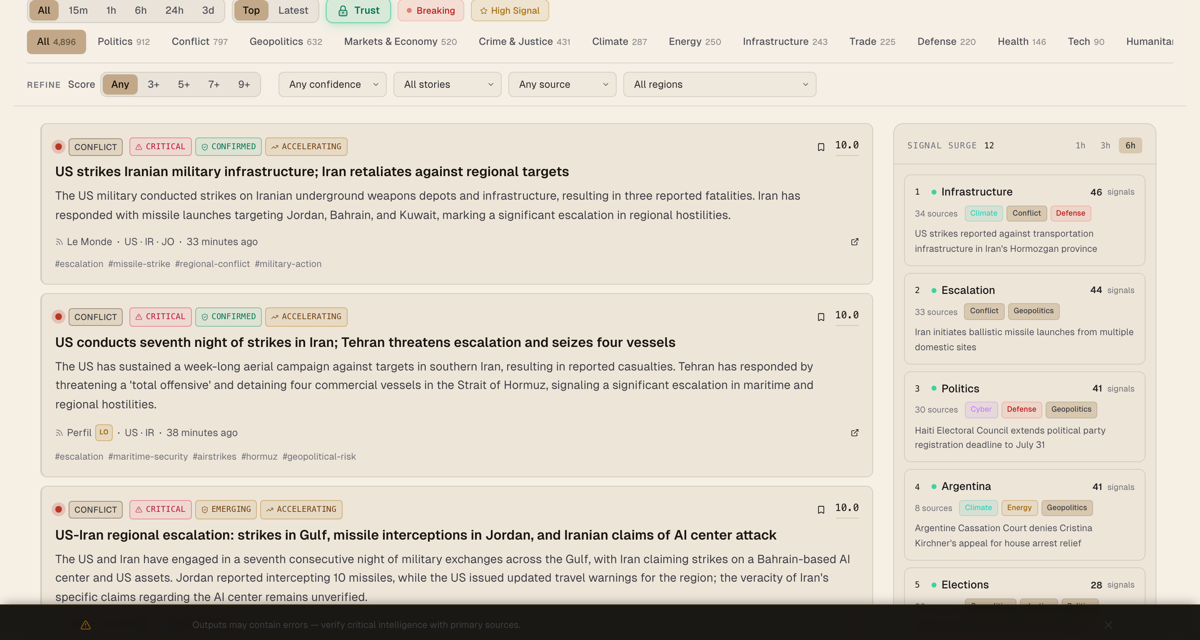
Monitor
Every scored signal as it lands, filterable by topic, country, and source trust before you read it. This is the surface that changes hour to hour.
Open without an account
Baseline-aware intelligence
Mosaic compares global reporting, market activity, and selected physical signals with their historical baselines. It surfaces unusual changes while keeping the supporting evidence, freshness, and coverage limits attached.
The Feed, Situations, Map, Research, and Anomalies are open without an account.
450+ sources monitored · 280+ producing signals in a typical 24 hours · signals across 170+ countries · baselines recomputed every 15 minutes.
Coverage snapshot verified August 19, 2026.
Zero items in 24 hours against a norm near 9.9 a day. The endpoint continued returning successful responses, but produced no items. Mosaic records that separately from a collector outage.
Coverage ran 3x its 30-day norm, 21 mentions in 24 hours against about 7 a day.
Mosaic recorded 15 underway vessels without subsequent transmissions during the observation window. Receiver gaps could not be excluded, and the record preserves that limitation.
Three detections from the production record, each shown with the date it was observed. Severity measures distance from that subject’s own baseline. These are dated records rather than a current view of the system.
How it works
Most of what Mosaic watches is reporting. The clearest way to show the method is a case where the absence of reporting was the finding.
Learn the baseline
Mosaic tracks how much each source normally publishes, how much coverage a place or entity normally attracts, and how vessels normally behave inside a watched box. NHK World’s publication norm sat near 9.9 items a day.
Notice the departure
On 2026-08-09 that source produced nothing for 24 hours. The reading is scored against NHK World’s own record, not against a global average, so a quiet source is judged by what it usually does.
Separate the world from the sensor
The same record carries 284 successful responses and no errors. The endpoint continued returning successful responses, but produced no items. Mosaic records that separately from a collector outage, and does not infer why the items stopped.
Attach the evidence
Related signals group into a record carrying trajectory, key facts, and the underlying items. Confirmed has a definition: two or more independent sources. A single source, however credible, stays labelled single-source.
No step predicts anything. Mosaic measures distance from what it has already observed, and every figure links back to the items that produced it.
The product
The surfaces below sit on the same evidence and differ in the job they do. Most are open without an account.
Monitor
Every scored signal as it lands, filterable by topic, country, and source trust before you read it. This is the surface that changes hour to hour.
Open without an account
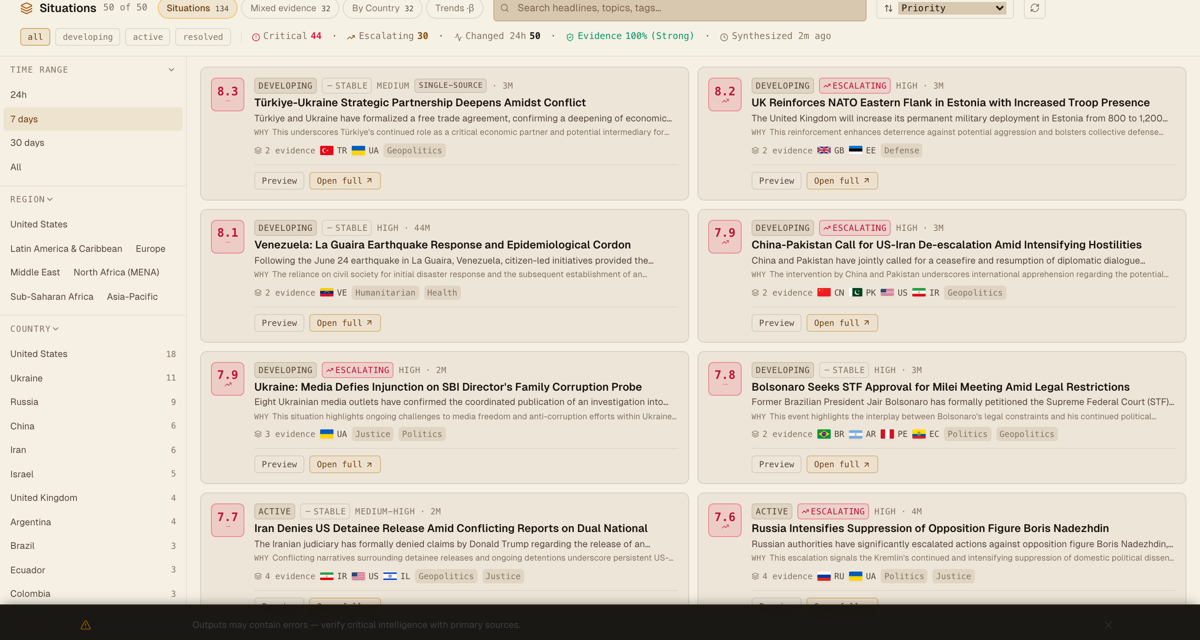
Understand
Related signals organized into evidence-linked records. Public records appear only after coherence and evidence review.
Open without an account
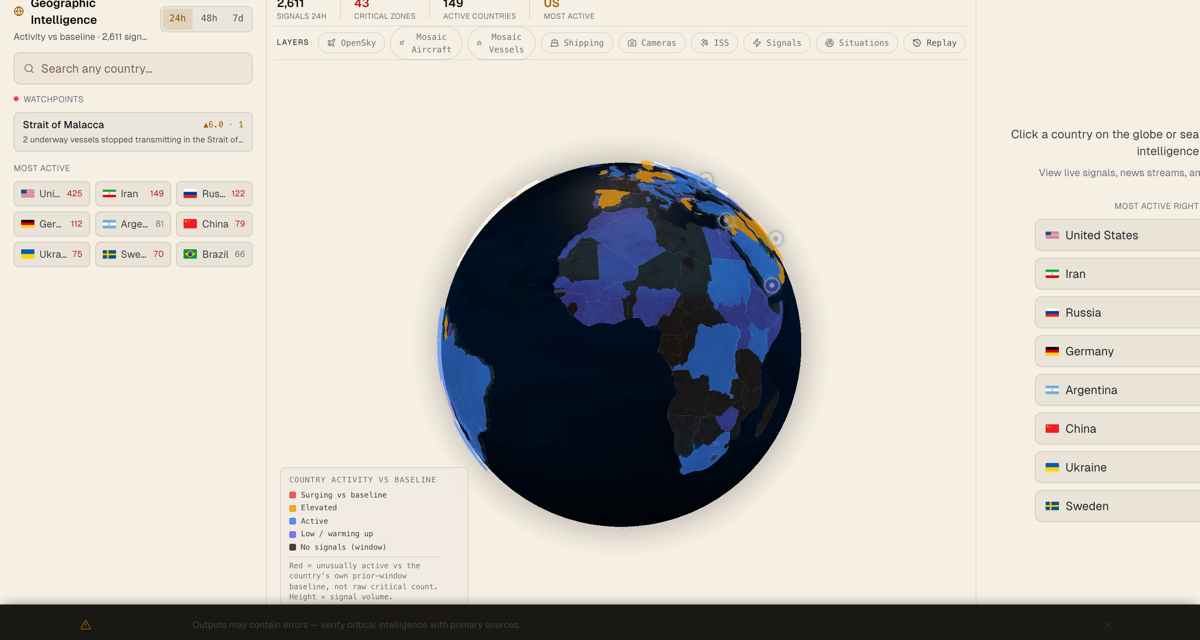
Investigate
Countries shaded by deviation from their own trailing baseline. A coverage gap is drawn as a gap rather than shaded as an alarm.
Open without an account
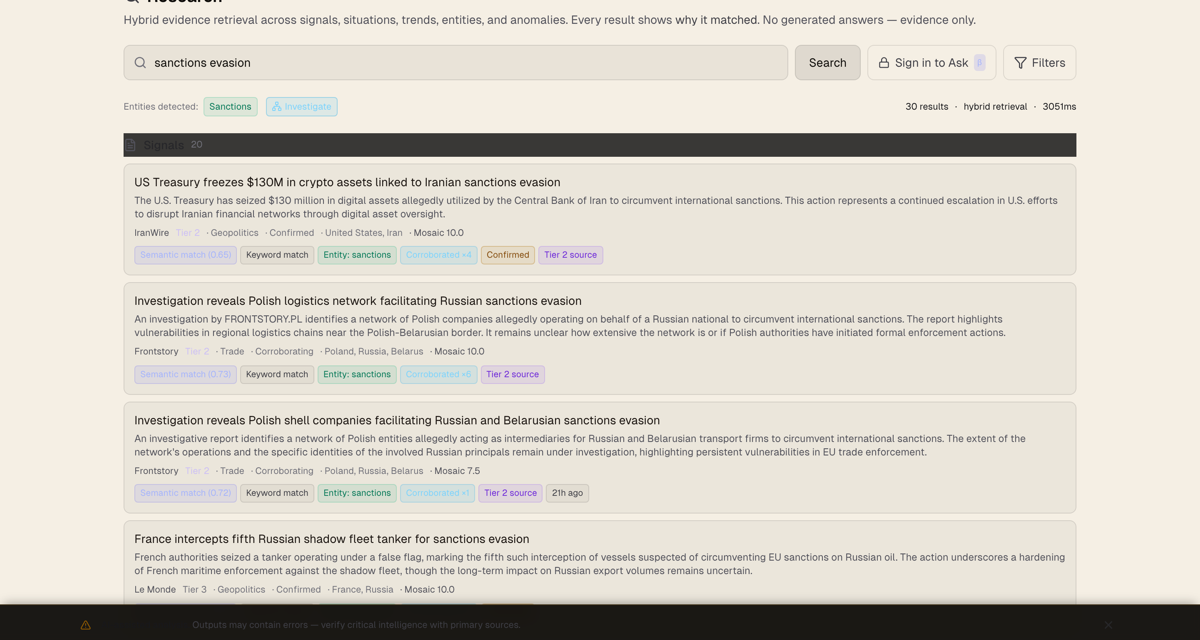
Investigate
Retrieval across signals, records, and entities, where every result shows why it matched and answers cite the items they rest on.
Open without an account
Also open without an account
Anomalies shows the detector output itself, with the baseline each reading was scored against and the maturity of that baseline. Open Anomalies
Methodology sets out how every score is computed and where it stops. Read the methodology
Follow, with an account
Workspace keeps your saved records, entities, and working notes in one place.
Watches and alerts stand over the countries, entities, and chokepoints you depend on, and evaluate as new evidence lands.
Morning brief is a daily digest built from the same evidence base.
Evidence and uncertainty
Scores compress evidence and never replace it. Everything below is inspectable down to the underlying items, and the limits are stated in the same type as the strengths.
What Mosaic computes
Source credibility is earned, not assigned. Every source is scored on its track record and capped below certainty, including wire services and official channels.
Corroboration is mechanical. Confirmed means two or more independent sources. One source, however credible, is labelled single-source.
Severity is distance from baseline. Each detector scores against its subject’s own trailing window, recomputed every 15 minutes.
Every number links back to its signals. Claim status, confidence, and severity are first-class fields rather than presentation.
What Mosaic does not do
It does not predict events. A severity score measures distance from baseline, not the probability of what happens next.
It withholds severity on young baselines. Until a baseline matures, detections carry reduced weight or none, which makes the system deliberately slower on new subjects.
Coverage gaps are reported, not filled. When a source stops producing or a receiver stops seeing, Mosaic records that separately from a real-world change.
It is machine-assisted and can be wrong. Every output links to primary sources, and critical intelligence should be verified there.
Read the full methodology, including how every score is computed →
Coverage
Monitored sources and recently producing sources are different figures, and Mosaic keeps them separate. Physical sensors are counted apart from sources, so one number never pads the other. The counts below were verified on August 19, 2026.
Open information
450+ sources monitored, of which 280+ produced a scored signal in a 24-hour window. Wire and national feeds sit alongside 90+ curated Telegram channels, each credibility-scored.
25+ source languages, machine-translated to English. Items that cannot be translated are labelled rather than silently mislabelled.
16 analyst topics across 7 macro-regions, from Conflict and Defense to Energy, Cyber, and Climate.
Physical signals
AIS ship tracking across 9 watch boxes, including Hormuz, Bab el-Mandeb, Suez, Malacca, the Taiwan Strait, the South China Sea, and the Black Sea.
Deviation scoring runs on 6 of those boxes, and the map shows which. Ingest coverage and detection coverage are not the same figure.
Baselines recomputed every 15 minutes, with severity withheld until a subject’s baseline has matured.
Sources are monitored, not partners. No outlet named or counted here endorses Mosaic, and Mosaic implies no endorsement in return.
Use cases
Track state and non-state behaviour against baseline rather than headline volume, and brief with an audit trail behind every figure: confirmed against claimed, per source, with trajectory.
Size a development against its own norm before the desk opens, alongside physical indicators most feeds never carry. An information service, not investment advice.
Watch the countries, chokepoints, and actors your operations depend on. Standing watches evaluate as new evidence lands, with the evidence attached.
Curated Telegram channels beside wire feeds, machine-translated and credibility-scored. Source silence is itself a detector, and every claim traces back to its primary.
The Feed, Map, Situations, Research, and methodology are open without an account. An account adds standing watches, alerts, and the morning brief.